Kootenai people
Train DreamsThe Kootenai people form one of the novel’s most important communities beyond the institutions of railroad companies, towns, churches, and county authorities. They appear as workers, neighbors, interpreters of animal life, participants in local rumor, and a people who maintain their own collective obligations even when white settlers reduce them to superstition or spectacle. Their presence gives the Moyea Valley a history and social depth that the language of empty wilderness repeatedly tries to erase.
Community and Borderland Setting
The Kootenai people live and move through the same northwestern borderland shaped by the Kootenai River, the Moyea Valley, rail lines, lumber work, and the towns around Bonners Ferry. Robert Grainier’s earliest memory includes the forced removal of more than a hundred Chinese families from Fry, an event witnessed beside the Kootenai River. Decades later, he nearly helps kill a Chinese laborer on a railroad bridge, and the memory links the community’s childhood experience of racial expulsion to the adult violence of company labor. The Kootenai people therefore occupy a landscape already organized by racial hierarchy, corporate power, and displacement rather than an untouched wilderness.
The community is not presented as isolated from town life. Kootenai individuals work at jobs in town, visit stores and homes, travel across the border from British Columbia, and appear at public gatherings. Kootenai Bob, a longtime acquaintance of Grainier, is described as steady, employed frequently in local work, and notably unwilling to drink liquor. His routine familiarity with Grainier contrasts with the sensational descriptions applied to other Kootenai figures, showing how the narrative’s social world alternates between ordinary contact and ethnic caricature.
Knowledge of Wolves and Animal Personhood
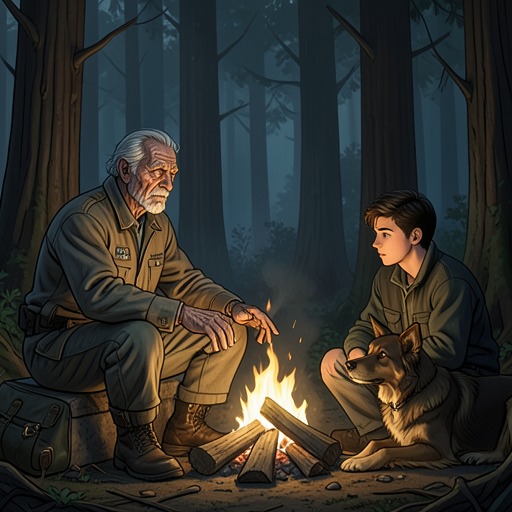
Kootenai Bob gives Grainier a distinctive account of wolf reproduction after Grainier’s red-haired dog produces four unusually wolfish pups. According to Bob, only one pair in a wolf den reproduces: the chief male of the wolf tribe mates with the only female in the pack that comes into heat. Bob initially rejects the idea that Grainier’s dog could have borne wolf pups, but allows that she might have encountered the dominant wolf at the precise moment of her fertility. His tentative conclusion is that Grainier may have a dog-of-wolf and may have begun his own pack.
This exchange does more than explain an uncanny litter. It places Kootenai knowledge against Grainier’s uncertain amateur interpretation and against the town’s later appetite for sensational rumor. Bob treats the boundary between dog and wolf as biologically and socially consequential, while Grainier experiences it through companionship, experiment, and longing. When Grainier tries to teach the remaining pup to howl, the animal refuses to answer the distant wolves. Bob then turns the episode into a warning: “There’s not a wolf alive that can’t tame a man.” The saying reverses the usual frontier fantasy of human mastery over animals and makes the human being the creature vulnerable to transformation.
The Kootenai people are also associated with a vocabulary that recognizes animals as persons. In the accounts repeated by Peterson, the Kootenais speak of “Coyote-person” and “Bear-person,” and regard animals as capable of occupying a category ordinarily reserved for people. Peterson presents this belief with contempt, associating it with paganism, witchcraft, Christianity, angels, devils, and beings that God supposedly did not create. Yet his own fear gives the belief narrative force: after his dog disappears for thirteen days and returns nearly wild, Kootenai Bob warns that the animal has been among wolves and may summon the wolf-girl into Peterson’s house. The Kootenai framework thus becomes a way of naming unstable relations among humans, dogs, wolves, and the unknown, even as white speakers distort it into a threat.
Stories, Rumor, and the Wolf-Girl
The Kootenai people are central to the circulation of the wolf-girl legend. Bob reports sightings, interprets the behavior of animals, and supplies the most elaborate warnings about the creature’s power. The story says that she was first seen years earlier leading a pack and that a visitor from Seattle saw her with a bloody mass between her legs. This sight is then transformed into competing explanations: it might have been an afterbirth or part of a wolf child torn from her womb. The uncertainty is important. The wolf-girl exists in the novel through testimony, fear, and conjecture before Grainier encounters her directly.
Settlers attach increasingly violent predictions to the rumor. The sheriff examines witnesses and considers them frank and sober, concludes that the creature is female, and hears fears that she will produce more hybrid pups and wolf-people. Public speculation escalates toward the idea that fire and blood alone could cleanse the valley, while the Kootenai people are accused of being especially vulnerable to Satan because of their supposedly pagan practices. The narrative exposes this as malicious talk by idle minds, later displaced by election controversies over silver and railroad land. Kootenai knowledge is therefore both used and discredited: settlers rely on it to make sense of the hills, then portray the people who preserve it as the source of the danger.
The fairground episode continues this pattern. Grainier encounters a middle-aged Kootenai woman and a nearly grown girl dressed in fringed blue buckskin, decorated with feathers, and displaying very wolfish pups taken from a feed sack, along with a bobcat held in a willow cage. A departing man declares that the dog-of-wolf will never be Christianized. The scene turns animal hybridity into a public exhibit and Christianity into a language of attempted control. The Kootenai women are not simply passive bearers of folklore; they possess the animals, stage their display, and participate in the production of meanings that the surrounding white spectators cannot fully control.
Death, Ceremony, and Collective Obligation
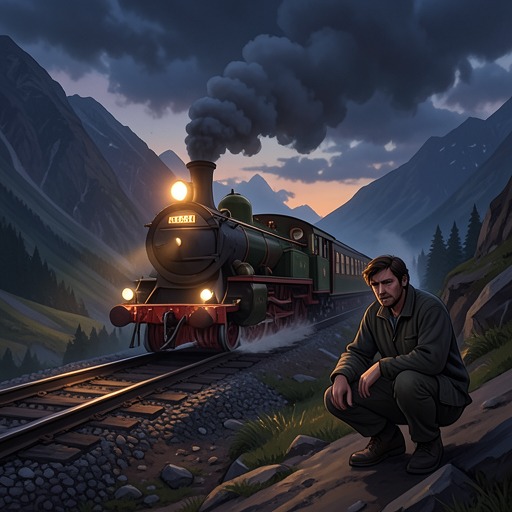
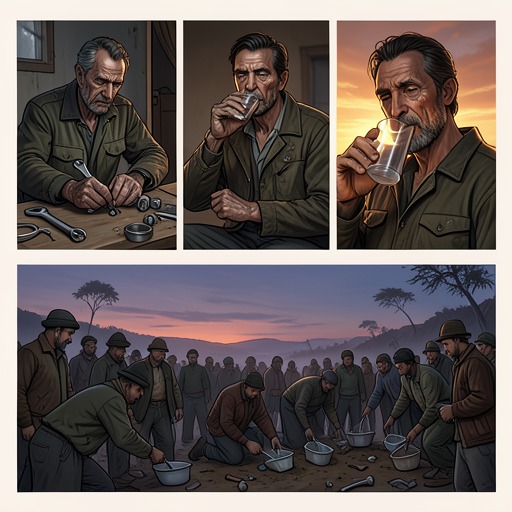
Kootenai Bob’s death reveals the community’s strongest collective action. In 1930, during the United States’ Prohibition, Bob drinks beer for the first time after visiting ranch hands from British Columbia persuade him that lemonade will cancel the alcohol’s effects. The drink becomes an eight-quart pan of beer, and Grainier finds Bob lapping at it, unable to speak and repeatedly having wet himself. After dark, Bob wanders onto the railway tracks and is run over by four or five trains. By the following afternoon, crows have drawn attention to the remains, which are scattered for a quarter mile along the right-of-way.
The response of the Kootenai people sharply contrasts with the chaotic violence surrounding the death. For several days, members of the tribe move along the blank earth beside the rails, locating pieces of flesh, bone, and cloth that the crows have missed. They place these fragments in brightly painted leather pouches and take them away for burial with a fitting ceremony. The act restores personhood to a body that industrial machinery has dismembered and that the railway corridor has reduced to scattered matter. It also makes communal care, rather than the train or the town, the final authority over Bob’s remains.
The Great Northern Railway’s management slows the trains and orders a series of long whistles so that the Kootenai tribe can collect what remains of their dead relative without further disarrangement. This gesture is limited and institutional, but it acknowledges the tribe’s right to recover him. The railway’s machinery has caused the dismemberment; its controlled interruption creates a narrow space for Kootenai mourning. The prolonged whistles then trigger an immense animal chorus of coyotes, wolves, and perhaps other creatures across the valley, binding industrial death, communal recovery, and the voices of the surrounding animals into one nightmarish landscape.
Historical and Narrative Significance
The Kootenai people complicate the novel’s account of settlement because they remain present wherever the region is treated as newly available: beside the river, in town labor, on the railway tracks, in local stories, and in the recovering forest. After the great fire, the valley’s animal population changes: spruce gives way to scraggly jack pine, wolves become less frequent and more distant, coyotes multiply, rabbits decline, and trout disappear from long stretches of the Moyea River. The Kootenai people’s animal knowledge provides a human record of these shifting boundaries, while their ceremonies preserve relationships that the fire, railway, and settler economy repeatedly disrupt.
Their representation is deeply contradictory. The narrative includes openly racialized labels and stereotypes, and white characters repeatedly describe Kootenai beliefs as pagan, witchy, or foolish. At the same time, Kootenai Bob is one of Grainier’s most trusted companions, his interpretation of the dog-of-wolf becomes a key to the novel’s animal world, and the tribe’s recovery of Bob’s remains is portrayed as disciplined, tender, and morally serious. The Kootenai people are thus not merely an exotic background group. They expose the instability of the categories imposed by the dominant society and preserve an alternative account of kinship in which human, animal, land, death, and memory remain materially connected.